Masked Autoencoders on STL-10
Self-supervised visual representation learning
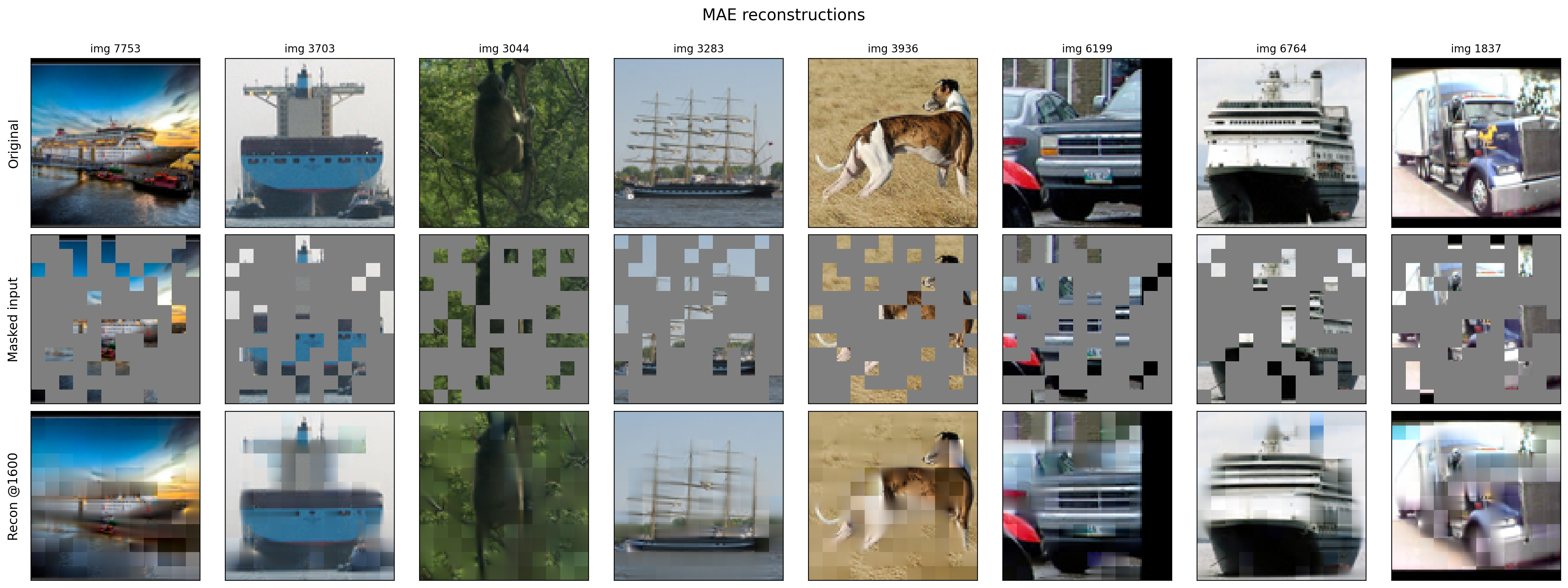
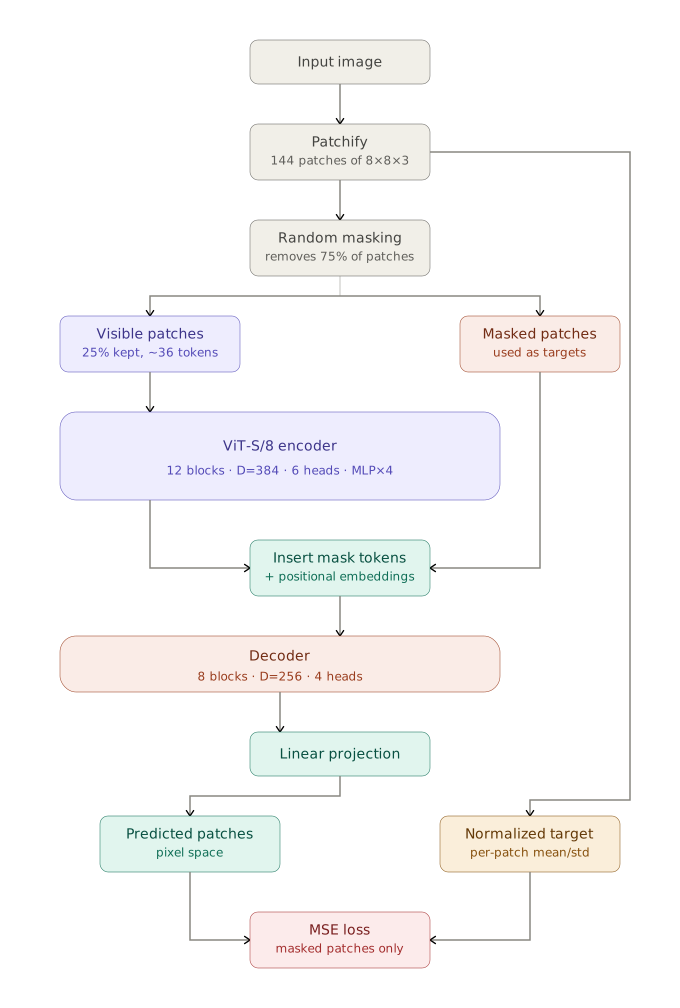
I trained a Masked Autoencoder from scratch on STL-10: a ViT-S encoder and an 8-layer decoder, with 75% of patches masked, for 1600 epochs on the 100k unlabeled images. Reconstruction quality mostly plateaus after the first few hundred epochs, but the learned representations keep improving. On the 8k-image test set at epoch 1600, a linear probe reaches 86.2%, an MLP probe 87.5%, and fine-tuning the last transformer block plus a linear head reaches 90.1% classification accuracy.
Approach
- Model. ViT-S encoder and an 8-layer decoder, trained with the MAE recipe (75% of patches masked, 25% visible).
- Data. STL-10: 100k unlabeled images for pretraining, 5k labeled for fine-tuning, and 8k for test.
- Implementation. From scratch in raw PyTorch (w/o Lightning).
- Training. 1600 epochs on one RTX 5090 via RunPod. First implementation was DDP with 2x Tesla T4s.
- Evaluation. Linear probe, MLP probe, and fine-tuning the last transformer block plus a linear head, following the paper’s ablation.
Generative Reconstructions
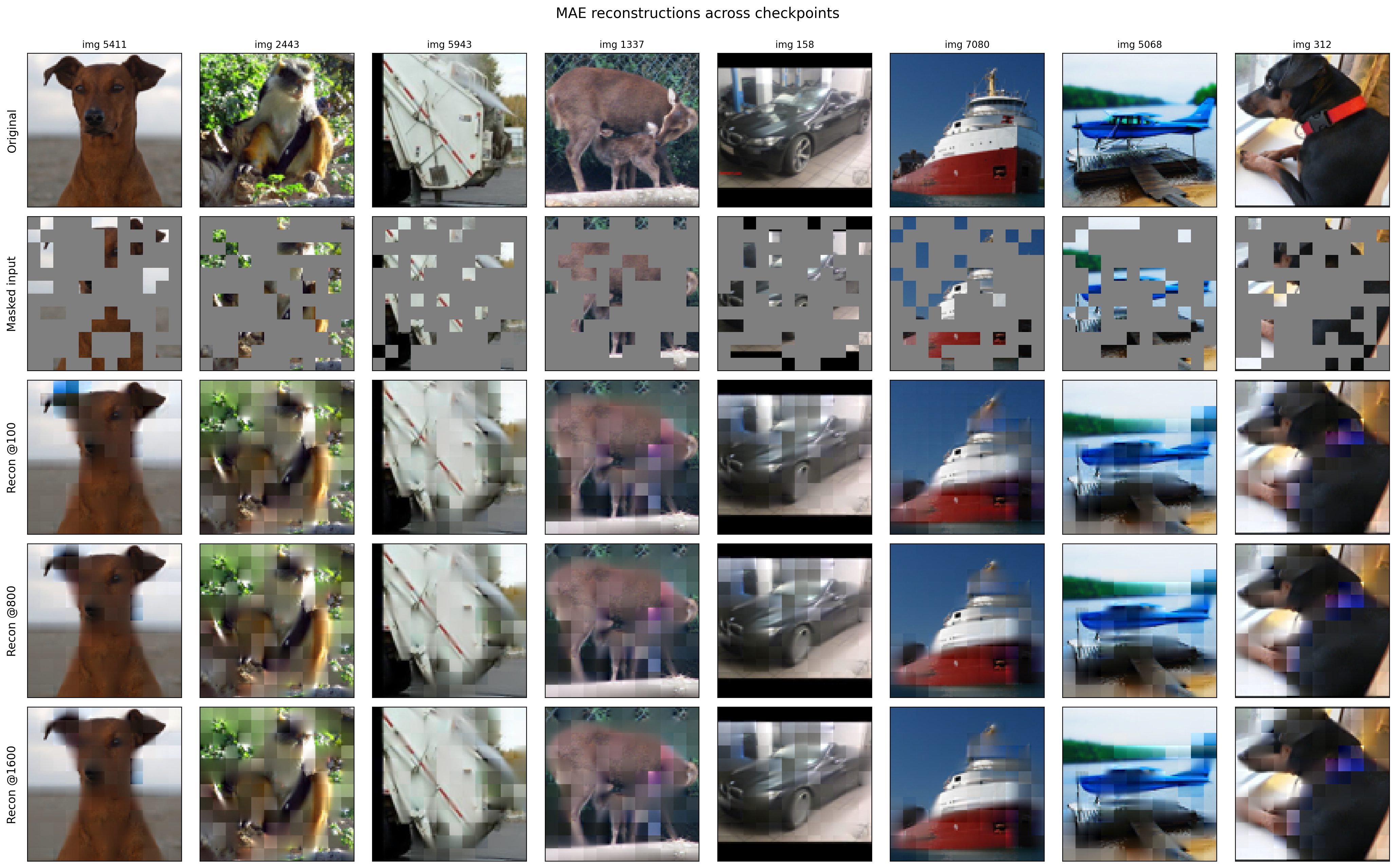
Reconstructions can be seen below at various training epochs. Reconstruction quality largely plateaus after the first few hundred training epochs, likely due to several factors including the limited size of the training set (100k vs. the MAE paper’s 1.28M ImageNet-1K images) and the limited capacity of the encoder, ViT-S. I did not elect to test a larger encoder because of the relatively small size of the training set. As seen in the next section, representation quality continued to improve even if reconstruction quality plateaued, which was also observed in the paper.
The significant color differences in some patches (like the blue patches on the dog's ear or the pink patches on the deer) are the result of using per-patch normalized pixels as the reconstruction target. This removes each patch's absolute mean and scale during training and, during visualization, reapplies these ground truth statistics to the predicted patch. This process emphasizes local structure/texture, but errors in the normalized precition sometimes appear as conspicuous reconstruction artifacts.
Downstream evaluation
I tested with frozen-encoder probes in 3 scenarios: linear probe, MLP head (linear → GELU → linear), and linear probe plus last transformer block fine-tuned. In all cases the decoder was dropped and switched out for the probes. The test set consisted of 8k images across 10 classes. The results show that downstream accuracy continues to increase with more training epochs but at diminishing returns. Higher epoch counts are most beneficial for the linear probe and only make a small difference for fine-tuning the last block.
| Method | Epoch 100 | Epoch 400 | Epoch 800 | Epoch 1600 |
|---|---|---|---|---|
| Linear probe | 70.74% | 82.16% | 85.09% | 86.21% |
| MLP probe | 73.25% | 83.06% | 86.54% | 87.45% |
| Last-block FT | 78.05% | 87.14% | 89.64% | 90.14% |
Learnings
- Seeing MAE try to learn every fine-grained texture in an image motivates me to pursue JEPA-style SSL approaches that more directly focus on the semantic representations of an image. Qualitatively, even at epoch 100, MAE has already learned much of the structure of the STL-10 images, but spends the remaining 1500 epochs on the laborious task of local pixel-level detail.
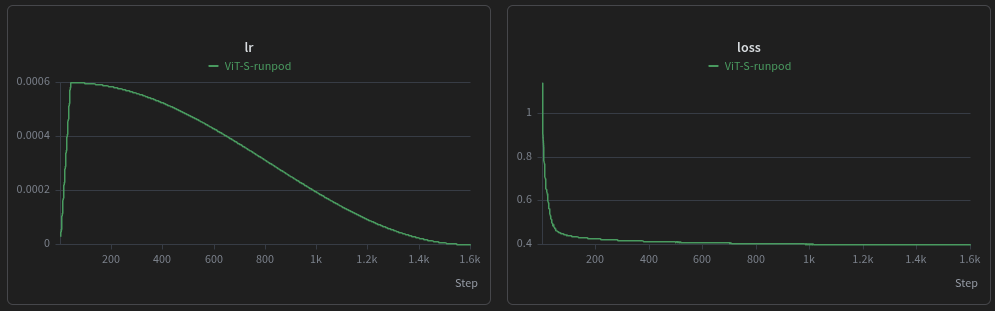
- Pay close attention to how a paper defines its learning rate. MAE reports a “base learning rate,” then applies a scaling rule to get the actual learning rate used during training. In my first implementation, I used the reported base LR directly with the paper’s batch size of 4096, which meant my effective learning rate was erroneously actually about 16× smaller than theirs.
- During fine-tuning the performance increased significantly when I remembered to turn off the masking and provide all of the patches to the classification head.
References
- Kaiming He, Xinlei Chen, Saining Xie, Yanghao Li, Piotr Dollár, and Ross Girshick. Masked Autoencoders Are Scalable Vision Learners. CVPR, 2022. arXiv:2111.06377